
DIATOM TEST SLIDES FOR OPTICAL MICROSCOPES (MICROSCOPE SLIDES OF SELECTED, MICROMANIPULATED TEST DIATOMS).
TEST YOUR MICROSCOPE! Venture into Micro- and Nano-structures!
“The use of Test Diatoms to check the quality of objectives is only one aspect of their use. The Test Diatoms should be also used to make sure that the whole system of the microscope is working well. That is the illumination as well as the combination of objective and eyepiece. It should become a habit to use a test slide every time the microscope is set up. In this way one ensures that what one sees is really there, not false and blurry images, and that one is missing nothing which should be visible with the optical system being used. Diatoms fill this requirement better than any other object” (from a classic N.B.S. leaflet).
OUR DIATOM TEST SLIDES ARE EXTREMELY USEFUL TO:
A) Evaluate and compare microscope models, objectives, eyepieces, condensers, light sources, optical filters and microscope cameras. They are perfect for testing techniques such as bright field, oblique illumination, differential interference contrast (DIC), phase contrast, dark field, polarized light, Rheinberg illumination and Hoffman modulation contrast;
B) Quantify resolution (the smallest distance between two points on a specimen that can be distinguished as separate entities) in optical microscopes;
C) Practice using your microscope at its highest level of performance;
D) Examine variations in contrast and resolution by regulating the condenser aperture diaphragm;
E) Understand the importance of the correction collar for minimazing spherical aberration.
Our diatom test slides are trusted by major microscope manufacturing companies for quality control and customer demonstrations.
Guaranteed Mounting: all micromanipulated diatoms are fixed directly to the underside of the optical-quality cover glass (rather than the microscope slide itself) for maximum resolution and contrast. The reason: objective performance drops significantly as the specimen distance from the cover glass increases (microscope objective lenses are designed to be optimally corrected for objects located immediately below the cover glass).
Diatoms are mounted in Diatom Lab’s proprietary high-refractive-index Diatom Cubed mountant. It is unalterable over time and has an R.I. > 1.7, ensuring maximum optical performance. Diatoms are attached to the underside of the cover glass by means of Diatom Lab's unique NANO-ADHESIVE, which is invisible even in phase contrast, darkfield illumination, differential interference contrast (DIC) and oblique illumination! This ensures all the finest Diatom details such as areolae, poroids, striae and so on, are always perfectly clean, regardless of the technique used, with the additional benefit that there are no traces, stains or swipe-marks caused by fixatives typically seen on some older preparations. Our NANO-ADHESIVE is also invisible to scanning electron microscopes (SEMs), and is therefore used to create a clean background for our SEM specimen preparations.
- Barone, S. 2023. Diatoms: the best microscopic objects to check, set and compare optical microscopes and contrast techniques, Microscopy and Analysis, 65: 13-18 (ISSN 2049-4424) link
- Barone S., 2022. Diatom Lab Microscope Test Slide in commemoration of Edmund J. Spitta, Micscape Magazine, 321 (ISSN 1365 - 070x) link
David Walker is the editor of Micscape Magazine:
- Walker D., 2023. Exploring the Diatom Lab 'Microscope Test Slide in Commemoration of Edmund J. Spitta' with Near UV . Micscape Magazine, 328 (ISSN 1365 - 070x) link
- Walker D., 2024. Exploring the Diatom Lab test slide Pinnularia dactylus var. dariana (A. Schmidt) Cleve 1895 at ca. 400 nm, Micscape Magazine, 339 (ISSN 1365 - 070x) link "Some time ago I treated myself to three single species diatom test slides prepared by Stefano Barone of Diatom Lab but it is only recently that I have started to explore them. From previous slides purchased I knew they were prepared to the very highest standards with the diatom touching the under side of the high spec. coverslip and use a proprietary Diatom Cubed high RI 1.7 mountant. A variety of test slides can be bought on the dedicated www.diatomshop.com website";
- Walker D., 2021. Note on 'diatom dotting' at low magnifications. Resolving Stauroneis phoenicenteron, Micscape Magazine, 306 (ISSN 1365 – 070x) “Acknowledgement: The author used the invaluable 'Test Slide version 2.0' (Diatom Cubed mountant) supplied by Stefano Barone of Diatom Lab"
- Bulletin of the Quekett Microscopical Club, Nov 2019, No.77, ISSN 1350-9128, pp 22-25: the article recognizes Diatom Lab preparations as expertly-prepared and three microscope images of our slides have been published, such as a detail of the Diatom Test Slide version 2.0 with the comment “image chosen by editor to show the incredible resolution of this excellent slide”
Diatom Test Slide version 3.0. Click on the PDF button to download the free instructions  | Microscope Test Slide in commemoration of Edmund J. Spitta. Click on the PDF button to download the free instructions   | Free article: Barone, S. 2023. Diatoms: the best microscopic objects to check, set and compare optical microscopes and contrast techniques, Microscopy and Analysis, 65: 13-18  |

DIATOM TEST SLIDES
Diatom Test Slide version 3.0. Download the FREE INSTRUCTION MANUAL through this website! The Diatom Test Slide version 3.0 groups test Diatoms ranging from easy to extremely difficult. Please open the two images. As with all our diatom micromanipulations, our proprietary high-refractive-index Diatom Cubed mountant was used for this microscope slide too This mountant is unalterable over time and has an R.I. > 1.7, ensuring maximum optical performance. (Not all Pinnularia nobilis diatoms are identical. For the Diatom Test Slide version 2.0 and 3.0, we selected the most challenging Pinnularia nobilis sample from our collection. Measurements performed via Scanning Electron Microscopy (SEM) confirm that poroid distances and dimensions vary among Pinnularia nobilis specimens worldwide).
Price without discount259.00 €

Diatom Lab Microscope Test Slide in commemoration of Edmund J. Spitta. Download the FREE INSTRUCTION MANUAL through this website! As in the case of test 2.0, this slide is also a complete test for all dry and oil immersion lenses from 10x to 100x, in Bright field, Oblique illumination, Phase contrast, Darkfield, Oil immersion darkfield and DIC. As with all our diatom micromanipulations, our proprietary high-refractive-index Diatom Cubed mountant was used for this microscope slide too This mountant is unalterable over time and has an R.I. > 1.7, ensuring maximum optical performance.
Price without discount259.00 €
DIATOM TEST SLIDES
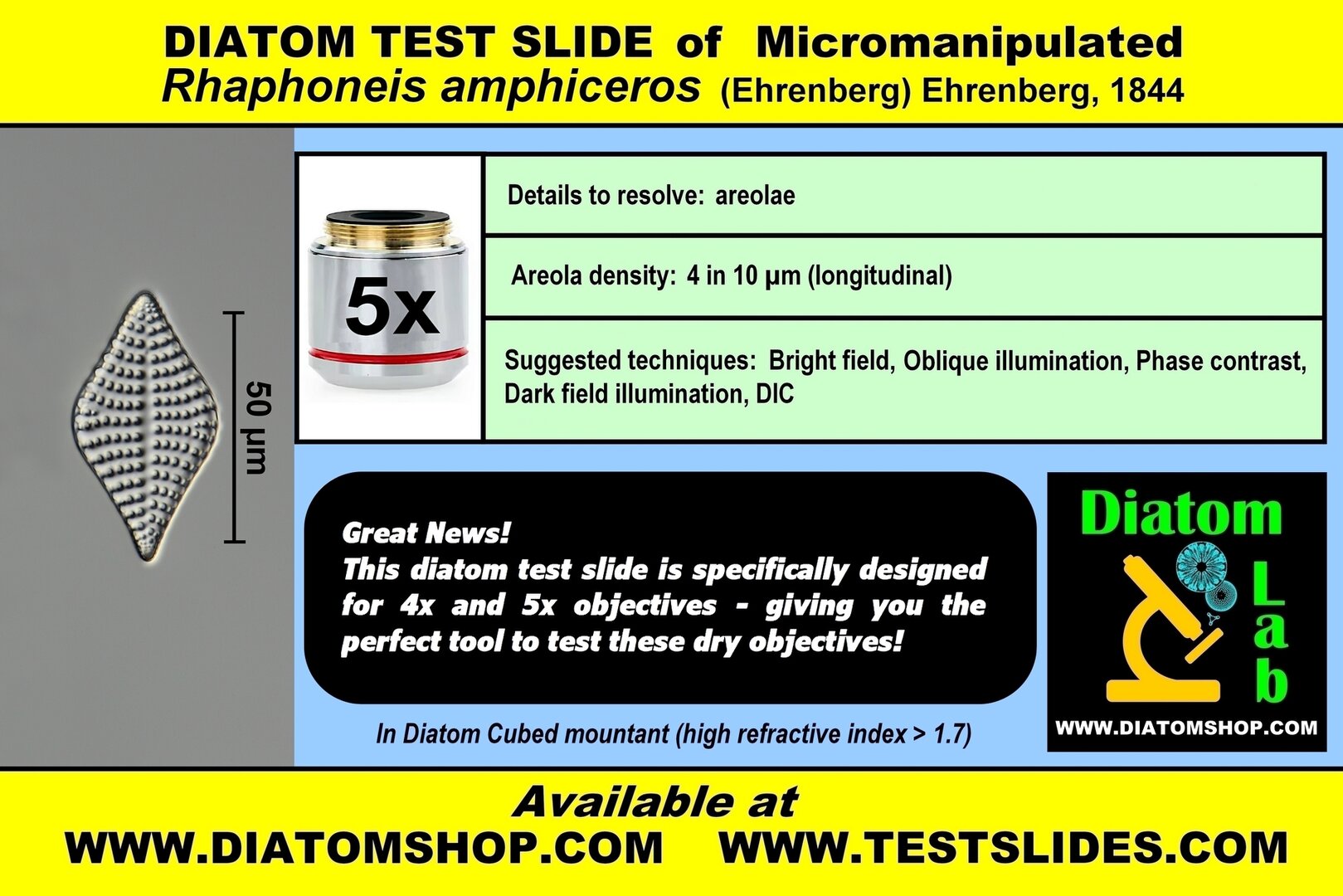
DIATOM TEST SLIDE of Micromanipulated Rhaphoneis amphiceros. Details to resolve: areolae. Areolae in 10 µm: 4 (longitudinal). Suggested techniques: 4x or 5x microscope objectives in Bright field, Oblique illumination, Dark field illumination, Phase contrast, Differential interference contrast (DIC). As with all our diatom micromanipulations, our proprietary high-refractive-index Diatom Cubed mountant was used for this microscope slide too. This mountant is unalterable over time and has an R.I. > 1.7, ensuring maximum optical performance.
Price without discount69.00 €
DIATOM TEST SLIDES
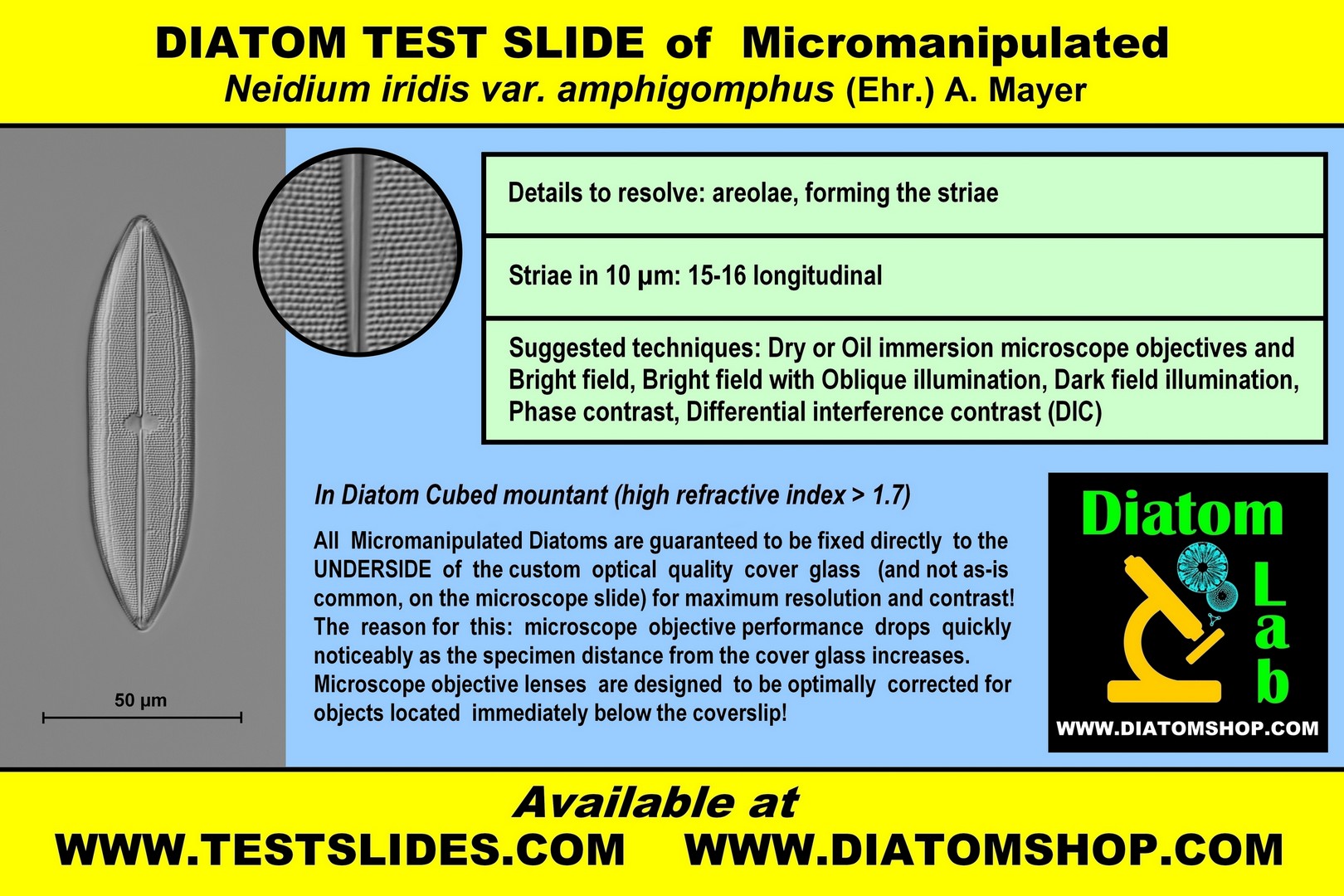
DIATOM TEST SLIDE of Micromanipulated Neidium iridis var. amphigomphus (Ehr.) A. Mayer. Details to resolve: areolae, forming the striae. Striae in 10 µm: 15-16 longitudinal. Suggested techniques: Dry or Oil immersion microscope objectives in Bright field, or Bright field with Oblique illumination, or Dark field illumination, or Phase contrast, or Differential interference contrast (DIC). As with all our diatom micromanipulations, our proprietary high-refractive-index Diatom Cubed mountant was used for this microscope slide too This mountant is unalterable over time and has an R.I. > 1.7, ensuring maximum optical performance.
Price without discount69.00 €
DIATOM TEST SLIDES
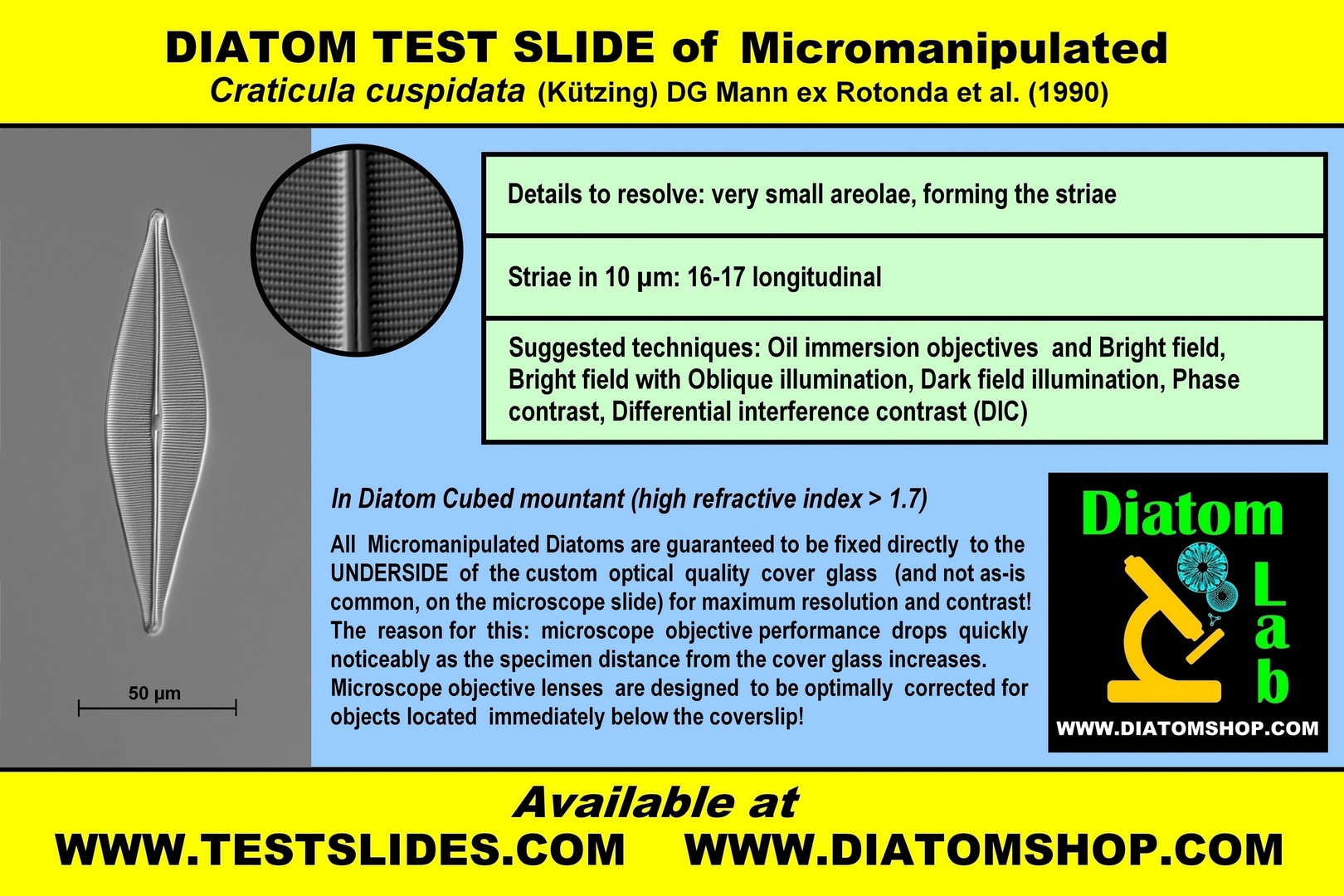
DIATOM TEST SLIDE of Micromanipulated Craticula cuspidata (Kützing) DG Mann ex Rotonda et al. (1990). Details to resolve: very small areolae, forming the striae. Striae in 10 µm: 16-17 longitudinal
Suggested techniques: Oil immersion microscope objectives in Bright field, or Bright field with Oblique illumination, or Dark field illumination, or Phase contrast, or Differential interference contrast (DIC). As with all our diatom micromanipulations, our proprietary high-refractive-index Diatom Cubed mountant was used for this microscope slide too This mountant is unalterable over time and has an R.I. > 1.7, ensuring maximum optical performance.
Suggested techniques: Oil immersion microscope objectives in Bright field, or Bright field with Oblique illumination, or Dark field illumination, or Phase contrast, or Differential interference contrast (DIC). As with all our diatom micromanipulations, our proprietary high-refractive-index Diatom Cubed mountant was used for this microscope slide too This mountant is unalterable over time and has an R.I. > 1.7, ensuring maximum optical performance.
Price without discount69.00 €
DIATOM TEST SLIDES
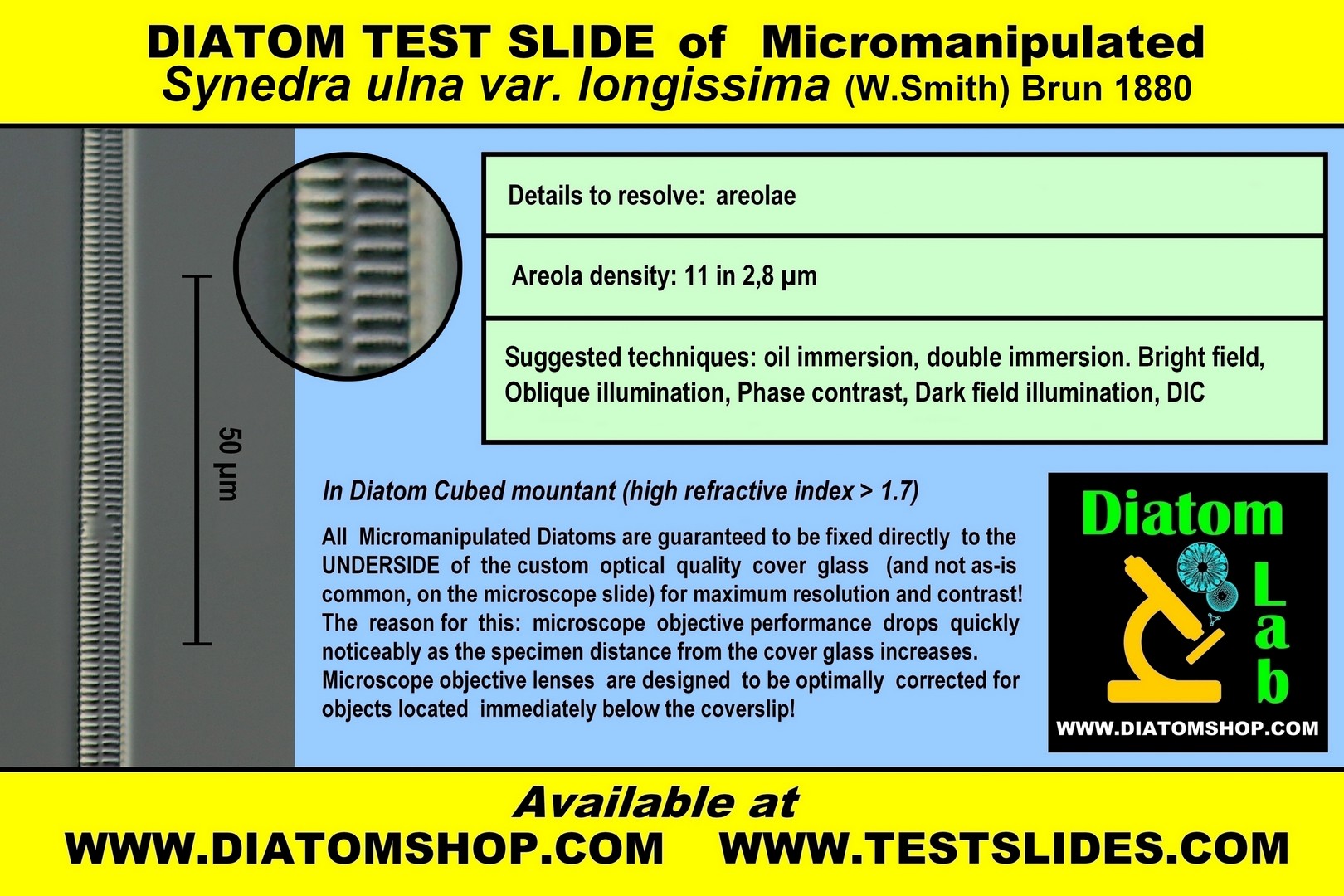
DIATOM TEST SLIDE of micromanipulated Synedra ulna var. longissima (W.Smith) Brun 1880.
Details to resolve: areolae. Areola density: 11 in 2,8 µm. Suggested techniques: Oil immersion, double immersion. Bright field, oblique illumination, Phase contrast, Dark field illumination, DIC. As with all our diatom micromanipulations, our proprietary high-refractive-index Diatom Cubed mountant was used for this microscope slide too This mountant is unalterable over time and has an R.I. > 1.7, ensuring maximum optical performance.
Details to resolve: areolae. Areola density: 11 in 2,8 µm. Suggested techniques: Oil immersion, double immersion. Bright field, oblique illumination, Phase contrast, Dark field illumination, DIC. As with all our diatom micromanipulations, our proprietary high-refractive-index Diatom Cubed mountant was used for this microscope slide too This mountant is unalterable over time and has an R.I. > 1.7, ensuring maximum optical performance.
Price without discount69.00 €
DIATOM TEST SLIDES
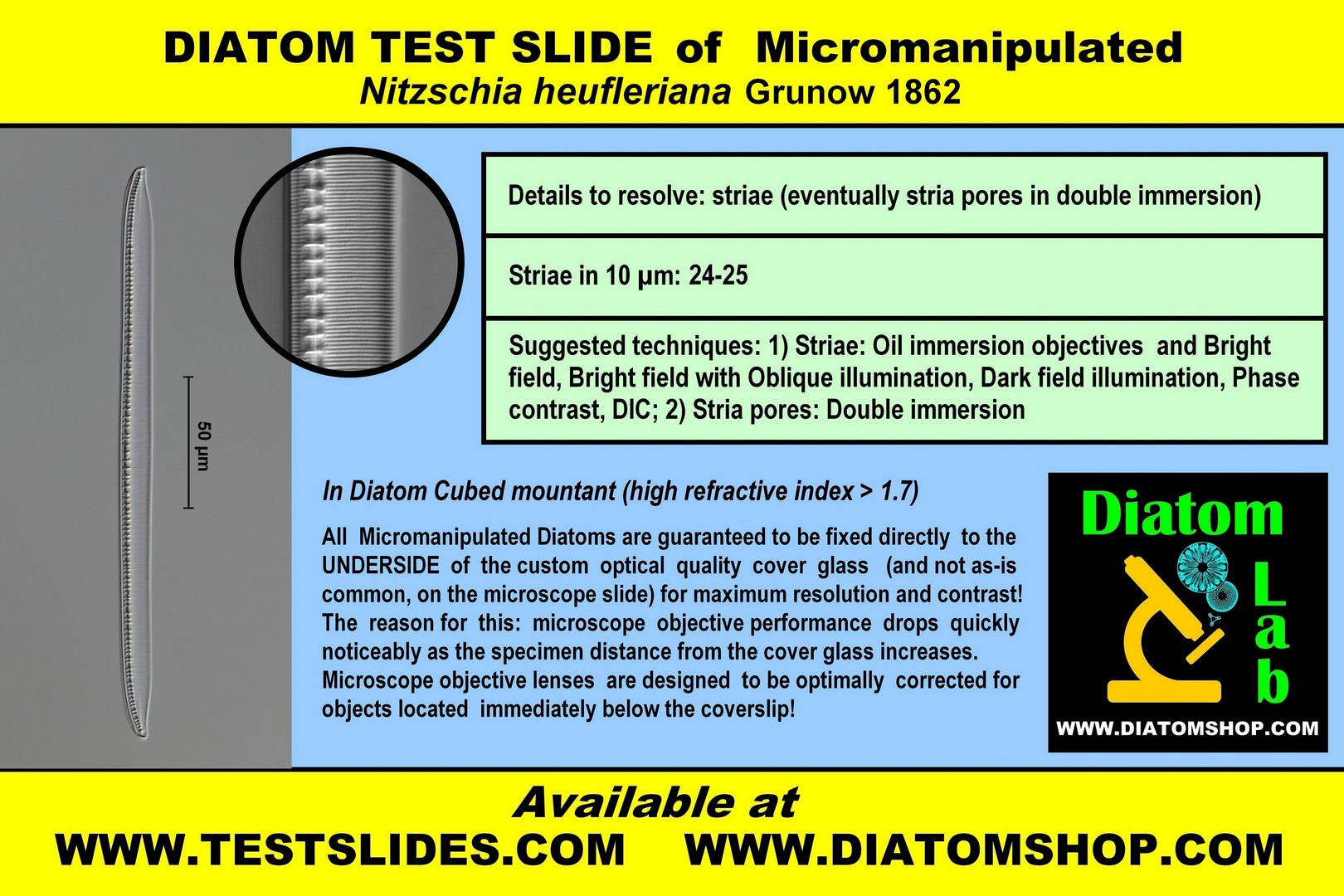
DIATOM TEST SLIDE of Micromanipulated Nitzschia heufleriana Grunow 1862. Details to resolve: striae or eventually stria pores in double immersion, Striae in 10 µm: 24-25, Suggested techniques: 1) For striae: Oil immersion microscope objectives in Bright field, or Bright field with Oblique illumination, or Dark field illumination, or Phase contrast, or Differential interference contrast (DIC); 2) For stria pores: Double immersion (= Oil immersion objective and Oil immersion condenser). As with all our diatom micromanipulations, our proprietary high-refractive-index Diatom Cubed mountant was used for this microscope slide too This mountant is unalterable over time and has an R.I. > 1.7, ensuring maximum optical performance.
Price without discount69.00 €
DIATOM TEST SLIDES
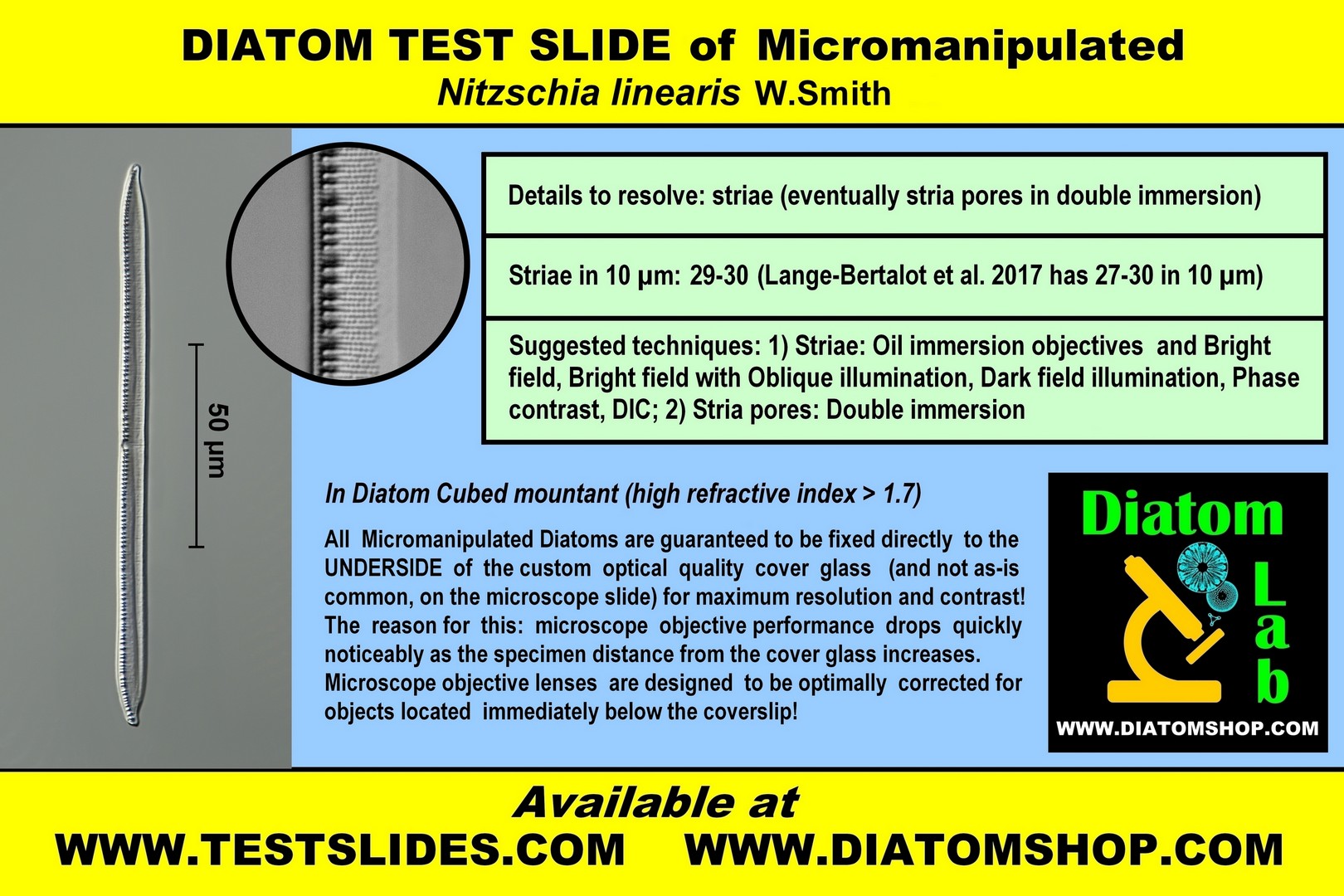
DIATOM TEST SLIDE of Micromanipulated Nitzschia linearis W.Smith. Details to resolve: striae or eventually stria pores in double immersion. Striae in 10 µm: 29-30, parallel. Suggested techniques:
1) For striae: Oil immersion microscope objectives in Bright field, or Bright field with Oblique illumination, or Dark field illumination, or Phase contrast, or Differential interference contrast (DIC); 2) For stria pores: Double immersion (= Oil immersion objective and Oil immersion condenser). As with all our diatom micromanipulations, our proprietary high-refractive-index Diatom Cubed mountant was used for this microscope slide too This mountant is unalterable over time and has an R.I. > 1.7, ensuring maximum optical performance.
1) For striae: Oil immersion microscope objectives in Bright field, or Bright field with Oblique illumination, or Dark field illumination, or Phase contrast, or Differential interference contrast (DIC); 2) For stria pores: Double immersion (= Oil immersion objective and Oil immersion condenser). As with all our diatom micromanipulations, our proprietary high-refractive-index Diatom Cubed mountant was used for this microscope slide too This mountant is unalterable over time and has an R.I. > 1.7, ensuring maximum optical performance.
Price without discount69.00 €
DIATOM TEST SLIDES
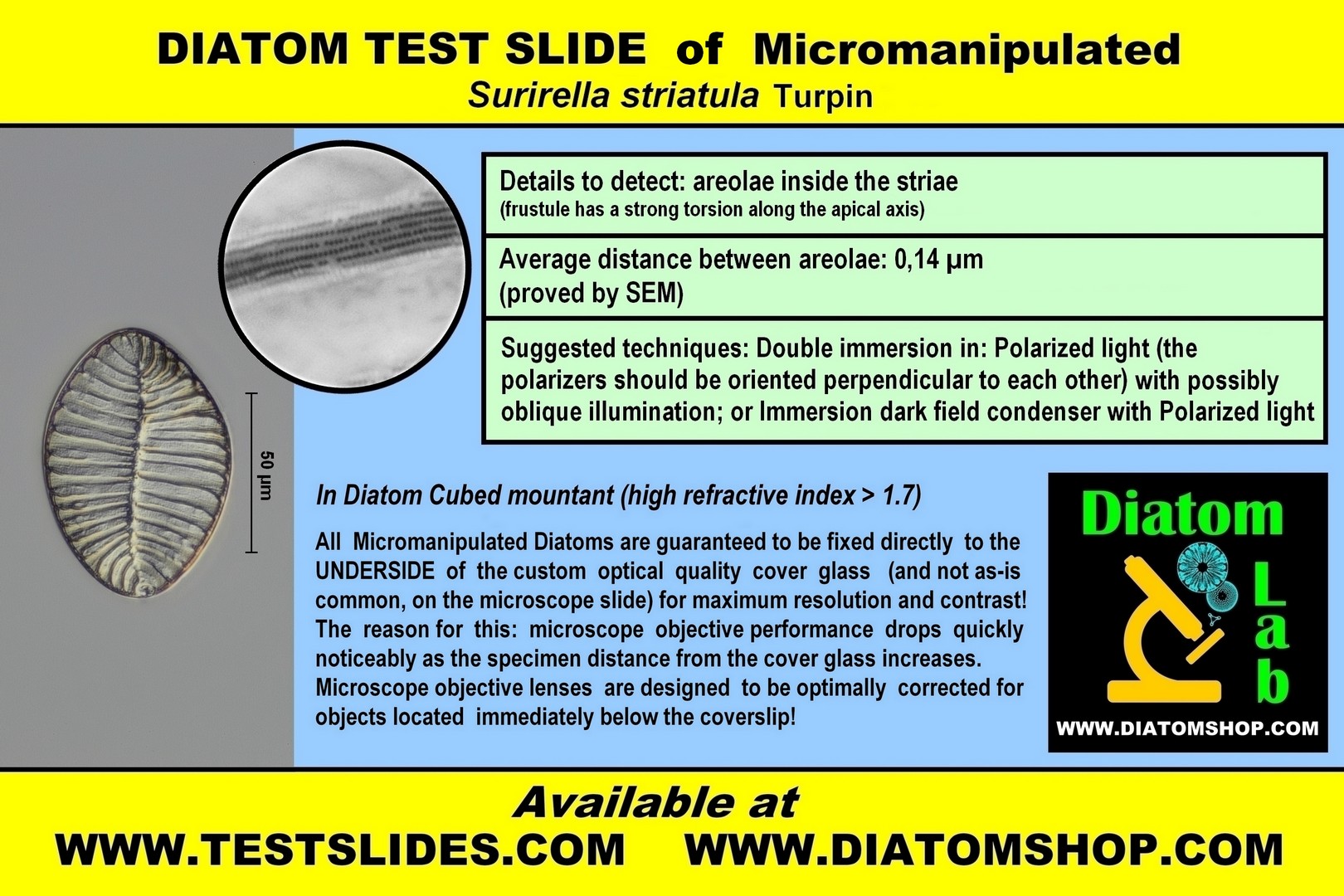
DIATOM TEST SLIDE of Micromanipulated Surirella striatula Turpin (in some cases frustule has a strong torsion along the apical axis). Details to detect: areolae, forming the striae. When viewed with SEM, the average distance between areolae is 0,14 µm. The theoretical limit of resolution of most light microscopes is ∼ 0.2 μm, but these areolae can be detected by the techniques below, thanks to Diatom Cubed high refractive index mountant and our proprietary techniques! Recommended microscope objectives: oil-immersion 63 or 100x objectives having a very good or excellent numerical aperture (1,3 or 1,4) Suggested techniques: Double immersion (= Oil immersion objective and Oil immersion condenser) in: Polarized light (the polarizers should be oriented perpendicular to each other = maximum level of extinction) with possibly oblique illumination; or Immersion dark field condenser (better 1,2/1,4) with Polarized light (the polarizers should be oriented perpendicular to each other = maximum level of extinction). As with all our diatom micromanipulations, our proprietary high-refractive-index Diatom Cubed mountant was used for this microscope slide too This mountant is unalterable over time and has an R.I. > 1.7, ensuring maximum optical performance.
Price without discount69.00 €
DIATOM TEST SLIDES
DIATOM TEST SLIDE of Micromanipulated Pinnularia dactylus var. dariana (A.Schmidt) Cleve
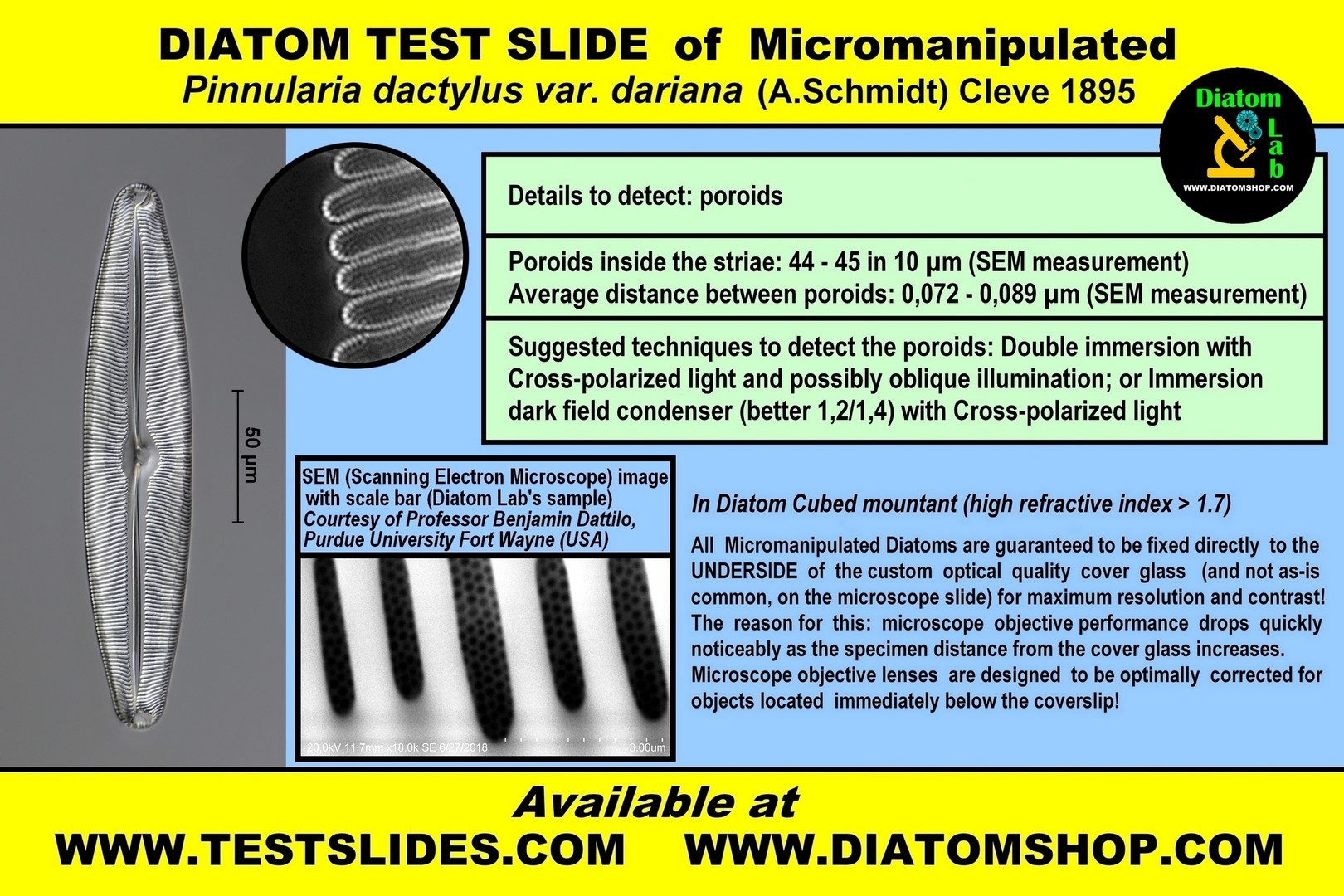
Details to detect: poroids. The theoretical limit of resolution of most light microscopes is ∼ 0.2 μm, but these poroids can be detected by the techniques below, thanks to Diatom Cubed high refractive index mountant! Viewed with SEM, QUANTITATIVE FEATURES in Diatom Lab's sample are: Poroids inside the striae: 44 - 45 in 10 µm; Average distance between poroids: 0,072 - 0,089 µm. See SEM image from the same sample! (While In Amphipleura pellucida striae number 37-45 in 10 µm and pores are spaced 0,16 - 0,19 µm apart). Recommended microscope objectives: Oil-immersion 63 or 100x objectives having a very good or excellent numerical aperture (1,3 or 1,4). Suggested techniques to detect the poroids: Double immersion (= Oil immersion objective and Oil immersion condenser) with Polarized light (the polarizers should be oriented perpendicular to each other = maximum level of extinction) and possibly oblique illumination; or Immersion dark field condenser (better 1,2/1,4) with Polarized light (the polarizers should be oriented perpendicular to each other = maximum level of extinction). As with all our diatom micromanipulations, our proprietary high-refractive-index Diatom Cubed mountant was used for this microscope slide too This mountant is unalterable over time and has an R.I. > 1.7, ensuring maximum optical performance.
Details to detect: poroids. The theoretical limit of resolution of most light microscopes is ∼ 0.2 μm, but these poroids can be detected by the techniques below, thanks to Diatom Cubed high refractive index mountant! Viewed with SEM, QUANTITATIVE FEATURES in Diatom Lab's sample are: Poroids inside the striae: 44 - 45 in 10 µm; Average distance between poroids: 0,072 - 0,089 µm. See SEM image from the same sample! (While In Amphipleura pellucida striae number 37-45 in 10 µm and pores are spaced 0,16 - 0,19 µm apart). Recommended microscope objectives: Oil-immersion 63 or 100x objectives having a very good or excellent numerical aperture (1,3 or 1,4). Suggested techniques to detect the poroids: Double immersion (= Oil immersion objective and Oil immersion condenser) with Polarized light (the polarizers should be oriented perpendicular to each other = maximum level of extinction) and possibly oblique illumination; or Immersion dark field condenser (better 1,2/1,4) with Polarized light (the polarizers should be oriented perpendicular to each other = maximum level of extinction). As with all our diatom micromanipulations, our proprietary high-refractive-index Diatom Cubed mountant was used for this microscope slide too This mountant is unalterable over time and has an R.I. > 1.7, ensuring maximum optical performance.
Price without discount79.00 €